BY MARY E. BELOW, MS, CCC-SLP
CHEWING AND SWALLOWING
are
things we often take for granted.
But for people who have dysphagia
(dis-FAY-juh), it can afect their
quality of life. Dysphagia is a
disorder that can afect any part of
the swallowing process. Swallowing
actually happens in three diferent
phases:
Te oral phase,
when we chew
and move foods or liquid in our
mouth to the back of the mouth.
Te pharyngeal phase,
when
the food moves into the throat
and is squeezed down toward the
esophagus. Tis is also the time that
the airway closes to prevent food
from “going down the wrong pipe.”
Te esophageal phase,
when
the food needs to go through the
opening at the top of the esophagus
and then get squeezed down into
the stomach.
There are many causes for
swallowing problems. A few
common causes are stroke,
Parkinson’s disease, multiple
sclerosis, ALS (Lou Gehrig’s disease),
head and neck cancer, and surgery.
Signs and symptoms of
dysphagia may include:
➜
➜
Coughing or clearing the throat
after swallowing.
➜
➜
Decreased voice quality
(sounding wet, hoarse or weak)
during meals.
➜
➜
Recurring chest infections or
pneumonia.
➜
➜
Needing multiple swallows or
posture changes to clear the throat.
➜
➜
Difculty completing a meal.
➜
➜
Feeling like food is stuck in your
throat.
➜
➜
Needing a modifed diet
(thickening or pureeing food, or
eating only soft solids).
➜
➜
Difculty initiating a swallow.
➜
➜
Spilling food or liquid (including
saliva) from lips.
Terapy can help
Tere is a treatment that has been
approved by the FDA since 2001
that speech pathologists can be
trained to use. Tis treatment is
called neuromuscular electrical
stimulation (NMES). It is used in
conjunction with conventional
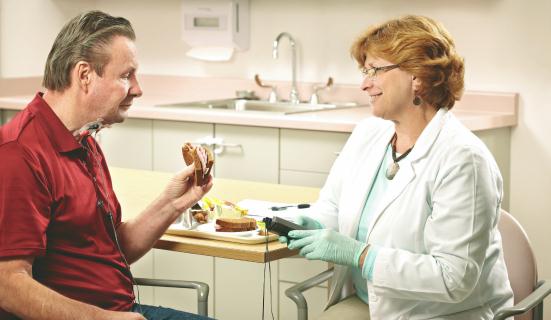
Russell Geiter, a stroke patient fromWabeno, and Mary E. Below, Speech Terapist
swallowing exercises that may
be completed during therapy and
also at home. Te goal of NMES
is to strengthen and re-educate
the muscular system and improve
motor control of the swallowing
mechanism.
If you think that you or someone
you care for may have dysphagia, talk
to a health care professional. Your
physician must write a prescription
for the speech pathologist to evaluate
and assess the need for NMES. Tis
may be accomplished by a clinical
swallowing evaluation; a swallow
study in x-ray; or consultations with a
gastroenterologist or an ear, nose and
throat specialist.
If it is determined that NMES
is right for you, therapy will
begin with establishing goals and
treatment. Your feedback to the
speech pathologist will determine
the course of treatment.
I have been trained and certifed
in the use of NMES for treatment of
dysphagia since May of 2009. If you
have any questions, please feel free
to contact me at Langlade Hospital
by calling
715-623-9459
.
Conquer dysphagia with neuromuscular electrical stimulation
Hard to
swallow
Hard to
swallow
14
Pathways • www.langladehospital.org