Join us for childbirth
education classes.
See page 2 for
dates and times.
MOST BABIES
enter this world
in the customary way. But 1 out
of 3 infants needs some extra
help arriving and is delivered via
surgery—or cesarean section.
If you are pregnant, your doctor
might suggest a cesarean section
(commonly called a c-section) if it
appears to be safer for you or your
baby than a vaginal birth.
While some c-sections are
planned because of a known
medical problem, most occur
unexpectedly when complications
arise during labor.
Rest assured, a c-section is
generally very safe for a woman
and her baby. It can even be a
lifesaving operation.
Why Surgery May Be
Needed
A c-section may be medically
necessary for many reasons.
Among them:
Your labor stalls.
About one-
third of c-sections occur because
labor either slows down or stops
altogether. If medications don’t
speed things up, a cesarean may be
needed.
Your baby is too large for your
pelvis.
Some babies are simply
too big to pass safely through a
woman’s birth canal.
Your baby is breech.
A baby
who enters the birth canal feet- or
buttocks-frst is considered in the
breech position. Your doctor might
be able to move the baby into the
less risky head-frst position before
labor starts. If not, a c-section may
be the best choice.
Labor is too stressful for your
baby.
A change in your baby’s heart
rate may indicate that your baby
When Extra Help Is Needed for Baby’s Arrival
DENNIS MCFADDEN, DO,
is the
most recent addition to our team of
women's health experts at Langlade
Hospital. He recently sat down with
Pathways
to talk about how he’s
settling in to his new job.
Q
How are you liking
Antigo so far?
A
I am very happy in our
decision to move to
Antigo. Tis past year has been a
whirlwind. My wife and children
have integrated well into the
community, and we attend Peace
Lutheran Church and love it. My
kids are now 4 years old and act as
if they have lived here the entire
four years.
Q
What attracted you
to our area?
A
I really like the small-town
hospital with a big-city type
of care: great technology, wonderful
nurses and team collaboration
is in trouble and needs to arrive by
c-section.
Tere are problems with
the umbilical cord.
Sometimes,
the cord becomes pinched or
compressed in labor. If this
happens, your baby may not
get enough oxygen. As a result,
an emergency cesarean may be
warranted.
Te placenta (afterbirth) covers
all or part of the lower end of your
womb.
Your baby’s exit from the
birth canal may be blocked if this
pregnancy complication, known as
placenta previa, occurs.
You’re expecting twins, triplets
or more.
Tough many women
carrying twins safely give birth in
the traditional way, those having
more than two babies usually
deliver by cesarean.
You’ve already had a c-section.
A past cesarean may mean that you
need one this time too.
American College of Obstetricians and Gynecologists
Looking Back on His First Year
among physicians.
Q
What is a typical
day like for you?
A
I am busy, seeing
18 patients a day,
old and young alike. I
specialize in prenatal
care, seeing expectant
mothers through delivery. In
fact, I have delivered 66 babies
since I arrived and feel very blessed
to be part of that.
Disorders of the menstrual cycle
(heavy bleeding, etc.) and basic
infertility problems are also among
the most common diagnoses that
I see.
I also specialize in
hysterectomies and bladder
reconstruction for the older
population. Tese are topics women
don’t necessarily like to talk about,
but they are very important to
having a good quality of life.
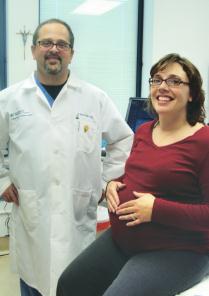
Dennis McFadden, DO, and one of his
patients, Karena Seefeldt. To make an
appointment with Dr. McFadden, call
the Aspirus General Clinic–Antigo at
715-623-2351.
4
Pathways • www.langladehospital.org